|
HISTORY
DIGITAL
COLLECTIONS
EVENTS: INTERNATIONAL DAY OF THE
MUSEUMS 18TH MAY
History
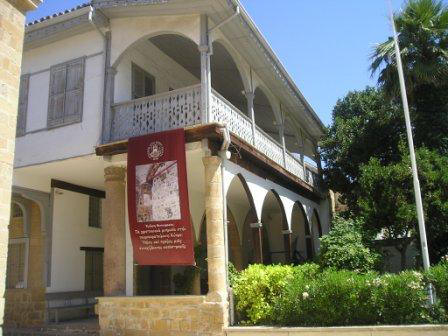 The
Cyprus Folk Art Museum was founded by a few keen members of the
Society of Cypriot Studies in 1937 and is housed in the premises of
the old Archbishopric Palace. In 1961 the seat of the Archbishop of
Cyprus was moved to the new palace. The Society then approached the
Archbishop who graciously handed over the whole of the premises of
the Old Archbishopric to the Society, to be used for its activities.
It was at that time from 1962 to 1964 that extensive reconstruction
of the The
Cyprus Folk Art Museum was founded by a few keen members of the
Society of Cypriot Studies in 1937 and is housed in the premises of
the old Archbishopric Palace. In 1961 the seat of the Archbishop of
Cyprus was moved to the new palace. The Society then approached the
Archbishop who graciously handed over the whole of the premises of
the Old Archbishopric to the Society, to be used for its activities.
It was at that time from 1962 to 1964 that extensive reconstruction
of the
 building
was carried out, at the very great
expense of the Society with the help of His Beatitude Makarios III (Diamantis,
1973, 1). building
was carried out, at the very great
expense of the Society with the help of His Beatitude Makarios III (Diamantis,
1973, 1).
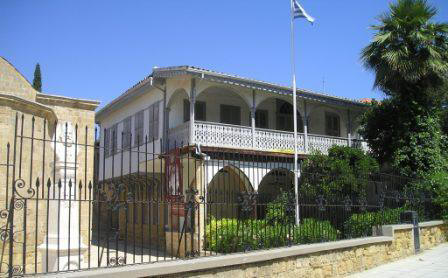
The
building of the Museum dates back to the 15th century and
is Gothic with earlier additions. In the beginning of
 the
13th century, the area was French (Latin) and was used as
a monastery by the order of the Benedictines. Besides, the Order of
St. John-Hospitaliers- built a church in honour of St. John, their
patron saint. Hugo 1st was buried here in 1218. The Greek
Orthodox Church began using it sometime before the Ottoman
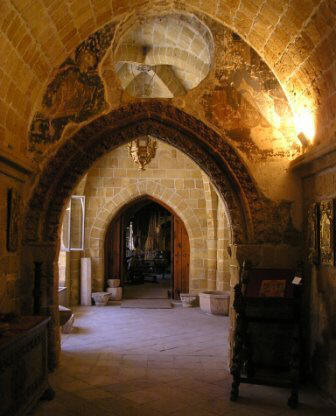
Occupation (1571-1878). The richly decorated Gothic arch with the 16th
century fresco of the Annunciation, which bears the end of a Greek
inscription was uncovered in 1950. The fresco was conserved in 1995
by the Society and the Department of Antiquities.Many of the items
of this museum were donated, others were bought either directly from
the villagers
or from
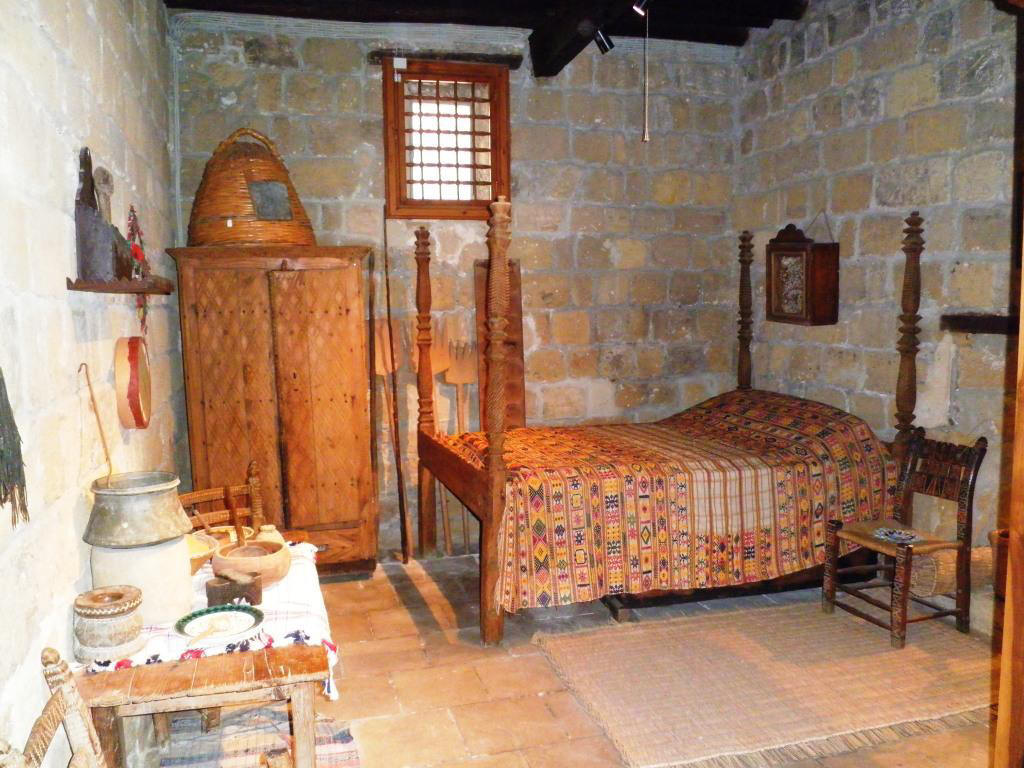
private collections. Most of the items were made in areas that are
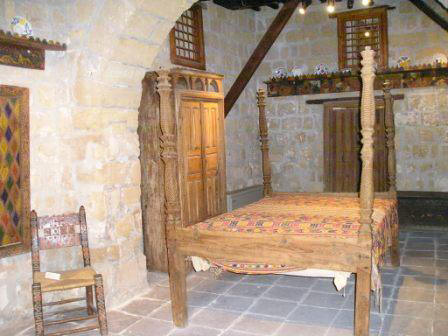
now occupied by Turkish troops. Samples of weaving, pottery,
embroidery, lace,
costumes, metalwork, woodcarving, basketry,
leatherwork, naïve painting, agricultural
and weaving tools
are to be found in the museum collections.
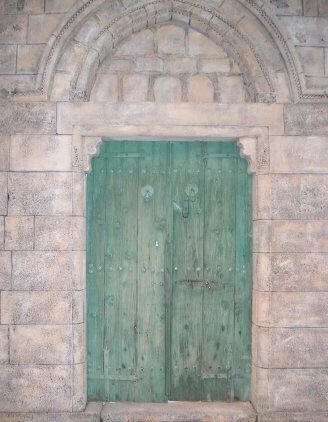
An important item is the door of St Mamas Church
(19ος),
that inspired the novel poet George Seferis. The poet refers to the
little owl of the door on his poem “Little things of Cyprus”. The
poem is dedicated to his friend and first Director of the Museum,
Adamantios Diamantis.
Today the number
of items catalogued is over 5000. the
13th century, the area was French (Latin) and was used as
a monastery by the order of the Benedictines. Besides, the Order of
St. John-Hospitaliers- built a church in honour of St. John, their
patron saint. Hugo 1st was buried here in 1218. The Greek
Orthodox Church began using it sometime before the Ottoman
Occupation (1571-1878). The richly decorated Gothic arch with the 16th
century fresco of the Annunciation, which bears the end of a Greek
inscription was uncovered in 1950. The fresco was conserved in 1995
by the Society and the Department of Antiquities.Many of the items
of this museum were donated, others were bought either directly from
the villagers
or from
private collections. Most of the items were made in areas that are
now occupied by Turkish troops. Samples of weaving, pottery,
embroidery, lace,
costumes, metalwork, woodcarving, basketry,
leatherwork, naïve painting, agricultural
and weaving tools
are to be found in the museum collections.
An important item is the door of St Mamas Church
(19ος),
that inspired the novel poet George Seferis. The poet refers to the
little owl of the door on his poem “Little things of Cyprus”. The
poem is dedicated to his friend and first Director of the Museum,
Adamantios Diamantis.
Today the number
of items catalogued is over 5000.
During 1955-1959 troubles, the Museum was forced to close in three
different occasions.
 Also,
in the summer of 1974 when the Turkish invasion took place, the
collection was transported to safer areas and the Museum was
closed for over a year’s period. Though, the adventures were not
over. The artifacts needed immediate conservation, the roof of the
building was about to collapse and the humidity was causing
irreparable damage to the exhibits. In 1990 His Beatitude Archbishop
Chrysostomos generously offered to cover the expenses and thus,
extensive repair work took place that was finished in April 1996
when the new exhibitions in the ground floor opened for the public. Also,
in the summer of 1974 when the Turkish invasion took place, the
collection was transported to safer areas and the Museum was
closed for over a year’s period. Though, the adventures were not
over. The artifacts needed immediate conservation, the roof of the
building was about to collapse and the humidity was causing
irreparable damage to the exhibits. In 1990 His Beatitude Archbishop
Chrysostomos generously offered to cover the expenses and thus,
extensive repair work took place that was finished in April 1996
when the new exhibitions in the ground floor opened for the public.
In June 1999, the Silk Industry
Exhibitions were inaugurated in the first floor of the building.
The old Archbishopric is situated in the
square named after Archbishop Kyprianos who was hanged by the Turks
in 1821 with the commencement of the Greek Revolution, so that it
would not spread in Cyprus that was under Ottoman rule as well as
the Greek mainland. Kyprianos was actually taken from a room in this
building to the place of his martyrdom. On the first floor there is
the room which was used by him and is known by his name. Across the
street is the Pancyprian Gymnasium, the oldest and largest gymnasium
in Cyprus, which is the continuation of the Greek school founded by
Archbishop Kyprianos in 1812 and dedicated to the Holy Trinity.
The museum has a rich shop with traditional
handicrafts and
also small gifts inspired of tradition woven bookmarks,shadowtheatre
figures, jewellery andbooks
concerning Cyprus
archaeology, tradition etc You can also try traditional drinks
like soumada (made of almond), rosewater and
cypriot coffee.
For groups it can be offered traditional
homemade pies, made in
satzi and pourekkia (a pie with white cheese-halloumi).
Volunteers are accepted to work in our museum,
as our
organization is based in volunteerism since
1937.
Erasmus + is an important annual
programme carried out at the museum and an opportunity for young
people to make their practice.
MUSEE D’ART POPULAIRE CHYPRIOTE
Le Musée d’Art Populaire chypriote, fondé en 1937 par certains
membres de Society of Cypriot Studies (organisation des études
chypriotes), est situé dans l’ancien Palais Archiépiscopal. En 1961,
le siège de l’Archevêché de Chypre fut transféré dans le nouveau
palais. L’Archevêque légua gracieusement les locaux de son ancien
palais à la Société pour ses activités. Entre 1962 et 1964, une
rénovation importante du monument fut réalisée et financée par
organisation des études chypriotes, avec l’aide du Bienheureux
Makarios III.
Le monument abritant le musée, qui date du 15e siècle, est construit
dans un style gothique comprenant des additions antérieures. Au
début du 13e siècle le site, alors Latin, était en effet utilisé
comme monastère par l’ordre des Bénédictins. Les membres de l’ordre
de Saint-Jean-de-Jérusalem nommés aussi « Hospitaliers »
construisirent une église consacrée à saint Jean. Hugues Ier de
Lusignan fut inhumé en ces lieux en 1218. L’Eglise Orthodoxe grecque
commença à utiliser le monument avant la domination ottomane
(1571-1878). La riche décoration gothique de l’arche, avec la scène
d’Annonciation qui date du 16e siècle, porte une inscription grecque
à son extrémité et elle fut découverte en 1950. La fresque fut
préservée par l’organisation des études chypriotes et le Département
des Antiquités. Beaucoup d’objets exposés dans ce musée sont le
fruit de donations ; mais d’autres furent aussi achetés directement
dans des villages ou des collections privées. La plupart d’entre eux
furent fabriqués dans des zones qui se trouvent aujourd’hui sous
occupation militaire turque. Plus précisément il s’agit des métiers
à tisser, des poteries, des broderies, des dentelles, des vêtements,
des objets métalliques, des sculptures en bois, de vannerie, de
maroquinerie, des peintures populaires, des objets agricoles et des
outils à tissage qui constituent les collections du musée. La porte
de l’église Saint-Jean du village Mamas (19e siècle), qui a inspiré
le poète George Séféris, est une pièce importante du musée. Le
célèbre poète cite la petite chouette, qui décore la porte, dans son
poème intitulé «Λεπτομέρειες στην Κύπρο» (détails sur l’île de
Chypre). Le poème est dédicacé à son ami Adamantios Diamantis,
premier directeur du musée. On peut aussi s’attarder sur deux
peintures murales d’un café traditionnel chypriote provenant d’un
village appelé Géri. Il s’agit d’une représentation d’un héros de la
Révolution Grecque contre les Turcs Ottomans en 1821, appelé
Athanasios Diakos ; et d’une autre d’un célèbre athlète appelé
Panagiotis Koutalianos, fameux pour sa force et ses performances
dans le monde entier. Deux autres peintures importantes sont celles
de M. Kassialos (Le Mariage) et de A. Stylianou (Lapithos). Ces deux
peintures représentent les coutumes et les travaux traditionnels
chypriotes. Aujourd’hui les collections du Musée comptent autour des
5000 objets.
À cause de la guerre civile des années 1955-1959, le musée fut forcé
de fermer ses portes à trois différentes occasions. Il en fut de
même durant l’été de 1974 lorsque l’invasion turque eu lieu. La
collection fut transférée en lieu sécurisé et le musée ferma pendant
un an. Mais ce ne fut pas tout : les artefacts nécessitèrent une
conversation immédiate ; le toit du monument fut sur le point de
s’effondrer et l’humidité causa des ravages irrémédiables aux
expositions. En 1990, son Bienheureux l’Archevêque Chrysostomos
offrit généreusement, non seulement à couvrir les dépenses, mais
aussi à agrandir le bâtiment. Les travaux furent achevés en avril
1996, lorsque la nouvelle exposition au rez-de-chaussée ouvrit ses
portes au public. En juin 1999, l’exposition Industrie de la Soie
inaugura le premier étage du bâtiment. L’ancien Palais
Archiépiscopal (aujourd’hui le musée) est situé sur la place nommée
par la suite Archevêque Kyprianos, à l’honneur de cet archevêque qui
fut pendu par les Turcs en 1821, au moment du commencement de la
Révolution Grecque ; afin que le mouvement contestataire ne se
propagea pas à Chypre, comme c’était le cas en Grèce continentale.
Kyprianos fut enlevé dans sa chambre, située dans ce bâtiment, pour
être transporté sur le lieu de son martyre. Sa chambre se situe au
premier étage, comme le témoignent les inscriptions. De l’autre côté
de la rue se trouve le Gymnase Panchypriote, le plus vieux et le
plus grand gymnase de Chypre, qui est l’héritier de l’Ecole Grecque
fondée par l’archevêque Kyprianos en 1812 et qui est dédié à la
Sainte Trinité.
Volkskunstmuseum
Zypern
 Das
Volkskunstmuseum Zypern wurde 1937 von einigen engagierten
Mitgliedern der Gesellschaft für Zypernstudien gegründet und im
alten Erzbischöflichen Palast untergebracht. 1961 wurde der Amtssitz
des Erzbischofs in den benachbarten Neuen Palast verlegt und das
alte Gebäude gänzlich der Gesellschaft für Zypernstudien für ihre
Aktivitäten zur Verfügung gestellt. Zwischen 1962 und 1964 ließ die
Gesellschaft für Zypernstudien das gesamte Gebäude gründlich
renovieren mit finanzieller Unterstützung des damaligen Erzbischofs
und Präsidenten der Republik Makarios III. Das Gebäude stammt
ursprünglich aus dem 15. Jahrhundert und ist im gotischen Stil
gebaut mit späteren Anbauten. Das
Volkskunstmuseum Zypern wurde 1937 von einigen engagierten
Mitgliedern der Gesellschaft für Zypernstudien gegründet und im
alten Erzbischöflichen Palast untergebracht. 1961 wurde der Amtssitz
des Erzbischofs in den benachbarten Neuen Palast verlegt und das
alte Gebäude gänzlich der Gesellschaft für Zypernstudien für ihre
Aktivitäten zur Verfügung gestellt. Zwischen 1962 und 1964 ließ die
Gesellschaft für Zypernstudien das gesamte Gebäude gründlich
renovieren mit finanzieller Unterstützung des damaligen Erzbischofs
und Präsidenten der Republik Makarios III. Das Gebäude stammt
ursprünglich aus dem 15. Jahrhundert und ist im gotischen Stil
gebaut mit späteren Anbauten.
In der Umgebung des Gebäudes befand sich in fränkischer Zeit das
Wohngebiet der Katholiken (Lateiner genannt) und beherbergte ein
Benediktinerkloster. In unmittelbarer Nachbarschaft befand sich die
Johanneskirche, gebaut vom Johanniterorden zu Ehren seines
Namenspatrons. Dort wurde 1218 der Lusignankönig Hugo I. begraben.
Diese Kirche wurde noch vor der Eroberung Zyperns durch die Osmanen
im Jahre 1571 in eine griechisch - orthodoxe Kirche umgewandelt.
Im Jahre 1950 wurde ein reichverzierter gotischer Bogen mit einem
Fresko aus dem 16. Jahrhundert entdeckt, das die Verkündigung Maria
darstellt und den Teil einer griechischen Inschrift zeigt. Dieses
Fresko wurde 1995 durch die Gesellschaft für Zypernstudien und die
zyprische Antikenverwaltung restauriert und gesichert. Viele der
Ausstellungsstücke des Museums sind Geschenke und Dauerleihgaben,
andere Exponate wurde entweder direkt in Dörfern oder von privaten
Sammlern erworben. Die Mehrzahl der Ausstellungsobjekte stammt aus
dem heute türkisch besetzten Norden Zyperns. Gezeigt werden gewebte
Stoffe, Töpferwaren, Stickereien und Spitzenwaren, Kleidungsstücke,
Metall-und Holzgegenstände, Schnitzarbeiten, Flecht- und Lederwaren,
naive Bauernmalerei sowie landwirtschaftliche Gerätschaften und
Webstühle.
Ein wichtiges Exponat ist eine Tür der St. Mamas Kirche aus dem 19.
Jahrhundert, in die eine kleine Eule
eingeschnitzt ist, die den berühmten zyprischen Dichter George
Seferis seinerzeit zu seinem Gedicht "Kleinodien Zyperns" inspiriert
hat, das er seinem Freund und ersten Direktor dieses Museums,
Adamantios Diamantis, widmete. Insgesamt verfügt das Museum über
mehr als 5000 katalogisierte Exponate.
Während der politischen Unruhen auf
Zypern zwischen 1955-1959 mußte das Museum dreimal schließen. Im
Sommer 1974 (griechischer Putsch und folgende türkische Invasion in
Nordzypern) wurde die Sammlung des Museums an einen sicheren Ort
ausgelagert und das Museum blieb für über ein Jahr geschlossen. Doch
damit nicht genug. Viele Exponate benötigten eine dringende
Restaurierung, das Dach des Museums war einsturzgefährdet und die
eindringende Feuchtigkeit richtete an vielen Stücken irreparable
Schäden an. 1990 bot schließlich der amtierende Erzbischof
Chysostomos großzügig dien Hilfe der Kirche an, wodurch umfangreiche
Reparaturarbeiten an Gebäude und Sammlungen ermöglicht wurden, die
im April 1995 abgeschlossen und die neuen Ausstellungsräume im
Erdgeschoß wiedereröffnet werden konnten.
 Im
Juni 1999 wurde die Seidenindustrieausstellung im ersten Stock des
Gebäudes eingeweiht. Das Alte Erzbischöfliche Palais steht an
Kyprianos - Platz, genannt nach dem zyprischen Erzbischof, der 1821
nach Beginn des Aufstandes gegen die osmanische Herrschaft in
Griechenland von den damaligen Herrschern Zyperns zur Abschreckung
gegen ähnliche Bewegungen auf Zypern zusammen mit vielen weiteren
kirchlichen Würdenträgern öffentlich hingerichtet worden war. Im
ersten Stock des Museums findet man noch heute den Raum, aus dem
Kyprianos zur Hinrichtung abgeführt wurde. Dem Museum gegenüber
steht das Gebäude des Panzyprischen Gymnasiums, der ältesten und
ehrwürdigsten höheren Schule auf Zypern, die 1812 von Erzbischof
Kyprianos gegründet und der Heiligen Dreieinigkeit gewidmet worden
war. Im
Juni 1999 wurde die Seidenindustrieausstellung im ersten Stock des
Gebäudes eingeweiht. Das Alte Erzbischöfliche Palais steht an
Kyprianos - Platz, genannt nach dem zyprischen Erzbischof, der 1821
nach Beginn des Aufstandes gegen die osmanische Herrschaft in
Griechenland von den damaligen Herrschern Zyperns zur Abschreckung
gegen ähnliche Bewegungen auf Zypern zusammen mit vielen weiteren
kirchlichen Würdenträgern öffentlich hingerichtet worden war. Im
ersten Stock des Museums findet man noch heute den Raum, aus dem
Kyprianos zur Hinrichtung abgeführt wurde. Dem Museum gegenüber
steht das Gebäude des Panzyprischen Gymnasiums, der ältesten und
ehrwürdigsten höheren Schule auf Zypern, die 1812 von Erzbischof
Kyprianos gegründet und der Heiligen Dreieinigkeit gewidmet worden
war.
Genießen Sie auch unser reichhaltiges handgefertigten zum shop
|
|